No products in the cart.
This post may contain affiliate links. If you purchase through these links, I may earn a small commission at no extra cost to you. This helps keep Pine+Mango running. Thank you for your support! Read our full disclosure here.
You’ve been curious about eating more plants. Maybe you’ve seen the headlines about health benefits, or you’re just tired of feeling sluggish after meals. But every time you look into it, everything sounds so…extreme.
Go vegan! Cut out all animal products! Follow these strict rules! Join this movement!
And you think: “I just wanted to eat more vegetables, not join a club or adopt a whole new identity.”
Newsflash: you don’t need to become anything to eat more plants. No labels or manifesto. No cutting out foods you enjoy.
You can eat more plants starting tomorrow without changing who you are or how you think about food.
This isn’t about perfection or purity—it’s about adding more of what makes you feel good.
Subscribe to Our Nourished Newsletter
Get free weekly guidance for your plant-based journey, straight to your inbox.
Table Of Contents
- You Don't Need a Label to Eat Well
- Why Eating More Plants Actually Works
- The Freedom of Not Going All-In
- How to Start: Small Shifts That Actually Work
- What This Looks Like in Real Life
- Letting Go of All-or-Nothing Thinking
- The Benefits You'll Actually Notice
- Handling Common Obstacles
- FAQs
- In Essence: No Labels Necessary
- Subscribe to Our Nourished Newsletter
You Don’t Need a Label to Eat Well
Let’s get this out of the way first: eating more plants doesn’t require you to become vegetarian, flexitarian, or any other “-arian.” Those labels can be helpful for some people, but they can also feel like pressure you don’t need.
The research is clear: you don’t have to eliminate meat to benefit from plants.
A 2024 study found that people who simply ate more plant-based foods while still including moderate amounts of meat had lower body mass index, better cholesterol levels, and improved blood pressure compared to heavy meat eaters.
The benefits come from what you add, not just what you remove.
Think of it this way: your body doesn’t care what you call yourself. It just responds to what you feed it.
More fiber? Your gut celebrates. More antioxidants? Your cells thank you. More nutrients? Your energy improves.
The label is optional. The benefits aren’t.
Why Eating More Plants Actually Works
Before we get into the how, let’s talk about the why—because when you understand what’s happening in your body, the whole thing makes more sense.
Your Body Runs Better on Plants
Plant foods are packed with fiber, vitamins, minerals, antioxidants, and thousands of beneficial compounds that your body uses for everything from repairing cells to fighting inflammation.
When you eat more plants, you naturally increase your intake of these nutrients.
Research shows that people eating plant-forward patterns have lower insulin levels, better triglyceride profiles, and reduced inflammation markers.
Translation? Steadier energy, fewer cravings, clearer thinking, and that post-meal energy slump becomes way less intense.
Inflammation Goes Down
Here’s something that changed how I think about food: plants contain natural anti-inflammatory compounds that actually neutralize the damage from pollution, processed foods, stress, and normal daily living.
Your body is constantly dealing with these stressors, and plants give it the tools to recover.
Lower inflammation means better mood, less joint pain, clearer skin, easier weight management, and reduced risk of chronic diseases.
You might not feel it immediately, but over weeks and months, the difference is undeniable.
Your Gut Gets Healthier
Your gut microbiome—the trillions of bacteria living in your digestive system—thrives on plant fiber. Different plant foods feed different beneficial bacteria, which is why variety matters.
Research shows that people who eat 30 or more different plant foods per week have more diverse gut bacteria, which supports better digestion, stronger immunity, and even improved mental health.
And yes, that includes whole grains, nuts, seeds, beans, herbs, and spices—not just fruits and vegetables.
Heart Health Improves
Multiple studies from 2023-2024 confirm that eating more plants while reducing (not eliminating) meat intake lowers your risk of cardiovascular disease.
We’re talking better cholesterol, healthier blood pressure, improved blood vessel function, and reduced risk of heart attacks and strokes.
These aren’t marginal improvements. They’re significant protective effects.
The Freedom of Not Going All-In
Here’s the part that makes eating more plants actually sustainable: you get to keep the foods you enjoy.
Want eggs for breakfast? Great. Love a good burger? Have it. Enjoy cheese on your pasta? Don’t stop.
The goal isn’t elimination. The goal is proportion—making plants the star more often while other foods play supporting roles.
This approach works because it removes the psychological trap of restriction. When nothing is forbidden, you stop obsessing. When you’re adding instead of subtracting, your brain doesn’t panic about deprivation.
Food becomes simpler, not harder.
Research shows that people following flexible plant-forward eating patterns have better long-term adherence than those attempting strict vegetarian or vegan diets.
Why? Because life happens. Birthdays, holidays, travel, bad days, celebrations—flexible eating accommodates all of it without guilt or failure.
How to Start: Small Shifts That Actually Work
Forget massive overhauls. Here’s what works in real life.
1. Start With One Meal
Pick one meal to make plant-focused most days. Breakfast is often the easiest.
Instead of eggs and bacon every morning, try oatmeal with berries and nuts a few days a week. Or whole grain toast with avocado and tomatoes. Or a smoothie with spinach, banana, and hemp seeds.
You’re not giving up eggs forever—you’re just eating them less often.
2. Add Before You Subtract
This is the golden rule. Always ask: “What can I add?” before you think about removing anything.
Making pasta? Add white beans and extra vegetables. Having a sandwich? Load it with lettuce, tomatoes, cucumbers, and sprouts. Eating tacos? Double the beans, add salsa, include extra cilantro and lime.
When you focus on adding plants, you naturally eat less of other things without feeling deprived.
Your plate is full. Your body is satisfied. But the ratio has shifted.
3. Keep It Ridiculously Simple
The biggest mistake people make? Overcomplications. You don’t need elaborate recipes or special ingredients to eat more plants.
Simple combinations that work:
- Canned beans + rice + salsa + avocado
- Hummus + whole grain pita + raw vegetables
- Oatmeal + fruit + nuts
- Baked sweet potato + black beans + greens
- Lentil soup + whole grain bread
- Pasta + marinara + white beans + vegetables
These aren’t Instagram-worthy meals. They’re real food that takes 10-15 minutes and actually fills you up.
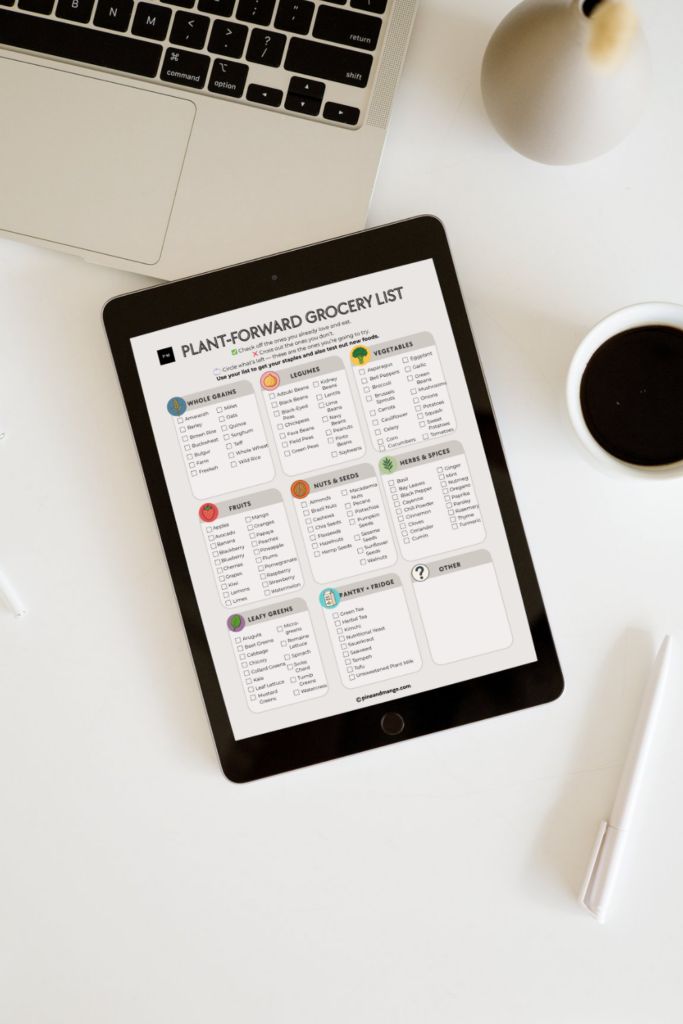
Get Your FREE Plant-Forward Grocery List Today!
4. Stock Your Kitchen Strategically
You’ll eat more plants when they’re convenient. Period.
Keep these on hand:
- Canned or dried beans and lentils (cheap, shelf-stable, versatile)
- Frozen vegetables (nutritionally identical to fresh, zero waste)
- Whole grains like brown rice, quinoa, or farro (batch cook on Sunday)
- Nuts and seeds for quick protein and healthy fats
- Fresh fruit you actually like eating
- Pre-washed greens for easy salads
- Nut butter, hummus, and other plant-based spreads
When hunger hits, you’ll reach for what’s easiest. Make plants the easy choice.
5. Use the “Mostly” Strategy
This is how most people naturally eat more plants without thinking about it: aim for plants to fill most of your plate.
Try the two-thirds rule: fill two-thirds of your plate with vegetables, fruits, whole grains, or beans. The remaining third can be whatever you want—chicken, fish, cheese, eggs, whatever sounds good.
No measuring. No perfectionism. Just a visual guideline that makes plants the main event without eliminating anything else.
6. Make Vegetables Not Boring
Let’s be honest: if vegetables tasted bad, you wouldn’t eat them. Roasting changes everything.
Toss vegetables with olive oil, salt, and pepper. Roast at 425°F until they’re caramelized and crispy. Brussels sprouts, broccoli, cauliflower, sweet potatoes, carrots—they all transform into something you’ll actually crave.
Season generously. Use garlic, herbs, spices, lemon juice, balsamic vinegar, soy sauce, nutritional yeast. Bland vegetables are the enemy of eating more plants.
👉🏿 If you’re just getting started, check out the Beginner’s Guide to Eating More Plants.
What This Looks Like in Real Life
Forget theoretical meal plans. Here’s what eating more plants actually looks like when you’re busy, tired, and just trying to make it through the week.
Monday
- Breakfast: Scrambled eggs with sautéed spinach and tomatoes, whole grain toast
- Lunch: Leftover lentil soup with a side salad
- Dinner: Stir-fry with tons of vegetables, tofu, and brown rice
Tuesday
- Breakfast: Oatmeal with banana, walnuts, and cinnamon
- Lunch: Hummus wrap with cucumber, bell peppers, lettuce, and chickpeas
- Dinner: Spaghetti with marinara sauce loaded with white beans and vegetables
Wednesday
- Breakfast: Smoothie with spinach, berries, banana, and almond butter
- Lunch: Burrito bowl with black beans, rice, salsa, avocado, and lots of veggies
- Dinner: Grilled chicken breast with roasted sweet potatoes and a big salad
See? Meat shows up. Eggs happen. But plants are the foundation. No rules. No restriction. Just more plants, more often.
Letting Go of All-or-Nothing Thinking
This is the part that trips people up. We’ve been conditioned to think that change only counts if it’s dramatic and complete.
But guess what? Eating plants four days a week instead of one makes a massive difference to your health. Adding vegetables to lunch when you used to skip them matters. Choosing fruit for a snack instead of chips counts.
Progress over perfection isn’t just a slogan—it’s the only approach that actually sticks.
Research confirms this. A 2020 study found that people who reduced meat intake without completely eliminating it still had significantly better health outcomes than those who made no changes.
The improvements came from degree of change, not dietary purity.
You don’t have to be perfect. You don’t have to be consistent every single day. No need to follow someone else’s rules about what “counts.”
You just have to keep choosing plants more often than you used to.
When You “Mess Up” (You Didn’t)
There will be days when you eat zero vegetables. Weeks when you survive on convenience food. Moments when you’re too tired to care about fiber or antioxidants.
That’s not failure. That’s life.
Eating more plants is a direction, not a destination. You can’t fail at a direction. You can only keep moving toward it, even imperfectly, even inconsistently.
Every meal is a new chance to add more plants. Not because you’re making up for yesterday. Because it’s what makes you feel good today.
The Benefits You’ll Actually Notice
Forget abstract health claims. Here’s what people report feeling within weeks of eating more plants:
⭐ Energy becomes steady. The 3 PM crash lessens. You wake up feeling more rested. Your energy doesn’t spike and crash throughout the day.
⭐ Digestion improves. Things move more regularly. Bloating decreases. Your gut just feels…better.
⭐ Cravings shift. This is weird but real: when you eat more nutrient-dense foods, your body stops desperately seeking chips and cookies. You might still want them sometimes, but the urgency fades.
⭐ Mood stabilizes. Fiber and nutrients from plants support your gut microbiome, which directly affects your mood and mental clarity. You feel calmer, clearer, less anxious.
⭐ Skin clears up. Less inflammation means fewer breakouts, less redness, better texture.
⭐ Recovery improves. If you exercise, you’ll notice you bounce back faster. If you don’t, you’ll notice everyday aches and pains decrease.
Handling Common Obstacles
“But I’m Always Hungry on Plants”
You’re probably not eating enough. Seriously. Plant foods are often less calorie-dense, which means you need to eat bigger portions.
Add healthy fats: avocados, nuts, seeds, olive oil, tahini. Include beans and lentils for protein and fiber. Don’t be afraid of whole grains.
Eat until you’re actually full, not what you think a “portion” should be.
“It’s Too Expensive”
Beans, lentils, rice, oats, seasonal vegetables, and frozen produce are some of the cheapest foods available. You’re thinking of expensive mock meats and specialty products. You don’t need those.
A 2021 study found that plant-forward eating patterns reduced food costs by up to one-third. Meat is expensive. Cheese is expensive.
Vegetables, grains, and beans? Shockingly affordable.
“I Don’t Have Time to Cook”
Neither do I. That’s why simple matters.
Batch cook grains and beans on the weekend. Keep canned beans in the pantry. Buy pre-washed greens and pre-cut vegetables. Use frozen vegetables. Make simple one-pot meals.
Embrace “good enough” instead of Instagram-perfect.
Most plant-forward meals take 15 minutes or less when you keep it simple.
“My Family Won’t Eat This Way”
You don’t need to convert anyone. Make meals that work for everyone, just shift the proportions on your own plate.
Taco night? Everyone gets tacos. You load yours with extra beans and vegetables. Spaghetti? Same sauce, you add white beans to your portion.
Burgers? They have beef, you have a black bean burger, everyone gets the same toppings.
Or take the side dish approach: make the protein flexible but load the table with plant-based sides everyone can eat.
FAQs
Q: Do I need to give up meat completely to benefit from eating more plants?
No. Research shows that simply increasing your intake of plant foods while moderating (not eliminating) meat consumption delivers significant health benefits.
One study found that flexible plant-forward eaters had better cardiovascular markers than heavy meat eaters, even though they still included animal products in their regular eating patterns.
Benefits come from eating more plants, not from achieving dietary purity.
Q: How much plant food should I be eating?
There’s no magic number, but a helpful guideline is the two-thirds rule: fill about two-thirds of your plate with plants (vegetables, fruits, whole grains, beans, nuts, seeds) and one-third with whatever else you want.
Research on gut health suggests aiming for 30 different plant foods per week to support a diverse microbiome, but this includes herbs, spices, nuts, seeds, and grains—not just produce.
Start where you are and gradually increase.
Q: What if I don’t like vegetables?
You haven’t found your preparation method yet. Roasting vegetables at high heat (425°F) with olive oil and salt completely transforms their flavor and texture—this is what converts most vegetable skeptics.
Experiment with different cooking methods (grilled, sautéed, air-fried), season generously, and start with milder vegetables like sweet potatoes, carrots, or bell peppers.
Also remember that beans, whole grains, nuts, and fruits all count as plant foods. You have options beyond salad.
📖 Good Reads: How Not to Die, The China Study and Plant-Based Nutrition
In Essence: No Labels Necessary
Eating more plants isn’t a commitment to a lifestyle or an identity. It’s not about joining a movement or following someone else’s rules.
It’s simply about adding more of what makes your body feel good.
No need to become anything. No need to eliminate anything.
You don’t need permission from anyone. You can keep the foods you love and still eat way more plants than you do right now.
Start with one meal. Add vegetables to something you’re already eating. Try a new bean recipe. Throw spinach in your smoothie. Keep it simple and flexible. Keep it yours.
The health benefits are real. The energy improvements are noticeable. The freedom from restriction is worth everything. But you’ll only discover this if you start—imperfectly, gradually, without pressure.
Your body doesn’t need you to be perfect. It just needs you to feed it well more often than you used to.
⭐Let’s chat: What’s one plant food you’re going to add to your next meal? Share in the comments—I’d love to hear what you’re trying!