
This post may contain affiliate links. If you purchase through these links, I may earn a small commission at no extra cost to you. This helps keep Pine+Mango running. Thank you for your support! Read our full disclosure here.
You changed your eating. Maybe you added more plants, started paying attention to ingredients, stopped grabbing whatever was easiest. That’s huge. And yet… something still feels off.
Your energy is unpredictable. Sleep is rough. Your mind won’t slow down. Sound familiar?
Here’s what I had to learn the hard way: food is only one piece of the puzzle. The daily habits that actually moved the needle for me weren’t found in another supplement or another wellness trend.
They were found in the basics. The simple, almost boring, wildly effective stuff that humans have done for thousands of years — and that modern life has quietly stripped away from us.
This isn’t about adding a 17-step morning routine to your life. It’s about coming home to your body. And once you start, you won’t want to stop.

Subscribe to Our Nourished Newsletter
Get free weekly guidance for your plant-based journey, straight to your inbox.
- Your Body Is Talking. Are You Listening?
- Movement: The Kind That Actually Feels Good
- Sleep: The Most Underrated Healing Tool You Have
- Hydration: Water Is More Powerful Than You Think
- Time in Nature: Your Nervous System's Reset Button
- Breathwork: The Tool You Already Carry With You
- Mindfulness: Presence as a Daily Health Practice
- How These Habits Work Together
- FAQs About Daily Habits
- In Essence: You Were Made for This
- Subscribe to Our Nourished Newsletter
Your Body Is Talking. Are You Listening?

Before we get into specifics, I want to say something important: your body is not broken. It is not your enemy nor is it betraying you.
It is a brilliantly designed system that has been doing its absolute best under enormous pressure — processed food, chronic stress, artificial light, sedentary hours, emotional exhaustion — and it has been sending you signals the whole time.
The fatigue, the brain fog, the restlessness, the cravings that never fully go away — those aren’t signs of failure. They’re signals. Invitations to slow down and pay attention.
Your body wants to be in balance. It is always, always working toward that. Your job is simply to stop fighting it and start cooperating with it.
What we’re doing here is learning to respond. To those signals, to those needs, with gentleness and consistency. That’s it. No perfection required. No dramatic overhaul overnight.
Just small, honest, daily choices that say to your body: I hear you. I’ve got you. We’re doing this together.
That shift in relationship — from fighting your body to partnering with it — is the foundation of everything.
Movement: The Kind That Actually Feels Good

Here’s what I learned about movement over time: it doesn’t have to hurt to count.
For years, I thought exercise meant pushing through pain, dreading it, and feeling guilty when I skipped.
The research tells a very different story.
Regular moderate movement — things like walking, stretching, cycling, swimming, or dancing — supports cardiovascular health, reduces systemic inflammation, improves mood through endorphin and serotonin release, and helps regulate blood sugar after meals.
One study found that even 11 minutes of moderate physical activity per day was associated with a significantly lower risk of cardiovascular disease and cancer.
Eleven minutes. That’s a walk around the block.
Here’s what actually works — and what you can start today:
1. Walk after meals.
Even 10 minutes improves blood sugar regulation and digestion by stimulating peristalsis — the muscular contractions that move food through your digestive tract.
This is one of the most underrated habits in existence, and it costs absolutely nothing.
2. Stretch in the morning.
Not a full yoga class — just 5 minutes on your floor. Move your spine in all directions, open your hips, reach your arms overhead.
Your fascia — the connective tissue that wraps around every muscle and organ — stiffens overnight. A few minutes of gentle movement wakes it back up.
3. Find movement you genuinely enjoy.
Dance in your kitchen. Garden. Swim. Hike. Play.
If it doesn’t feel punishing, you’ll actually keep doing it. And consistency over years is infinitely more valuable than perfection for a week.
4. Aim for consistency over intensity.
Three 20-minute walks this week beats one brutal gym session you dread and skip next week.
The goal is to make movement a non-negotiable daily companion, not a performance.
5. Incorporate incidental movement.
Take the stairs. Park further away. Stand while you take a phone call.
Research on non-exercise activity thermogenesis (NEAT) shows that these small, accumulated movements throughout the day have a meaningful impact on metabolic health over time.
Movement is medicine. It is ancient, free, and available to you right now. Your body was built to move — and it remembers how.
👉🏿 For a deep dive, read Easy Ways to Move Your Body Every Day.
Sleep: The Most Underrated Healing Tool You Have

We live in a culture that glorifies being busy and sleeping less. That culture is wrong, and it is making us sick.
Sleep is not laziness or a luxury. Sleep is when your body does its most essential repair work — and without it, everything else you do for your health is working against an uphill current.
During sleep, your body repairs damaged tissue, consolidates memories, balances hunger hormones like leptin and ghrelin, regulates cortisol, and clears metabolic waste from your brain through a process called the glymphatic system.
Your brain has a literal overnight cleaning cycle, and it only activates during deep sleep. When you consistently cut sleep short, that waste — including proteins associated with neurodegenerative disease — builds up.
And guess what: most people don’t realize how sleep-deprived they actually are. When you’ve been running on insufficient sleep for years, you adapt to it.
Here are simple natural wellness habits for better sleep:
1. Keep a consistent sleep and wake time, even on weekends.
Your circadian rhythm is a biological clock that thrives on regularity.
Every time you stay up late on Friday and sleep in on Sunday, you’re essentially giving yourself social jet lag — and your body spends the first half of the week recovering.
2. Dim your lights an hour before bed.
Artificial light, especially the blue-spectrum light from screens and LED bulbs, suppresses melatonin production by signaling to your brain that it’s still daytime.
Candles, salt lamps, or warm-toned bulbs are a genuinely helpful swap.
3. Keep your bedroom cool and dark.
Your body’s core temperature naturally drops by 1-2 degrees as you fall asleep, and a cooler room (around 65-68°F / 18-20°C) supports that process.
Blackout curtains are worth every penny.
4. Limit caffeine after 2pm.
Caffeine has a half-life of 5-6 hours, meaning that 3pm cup still has half its caffeine in your bloodstream at 9pm.
For sensitive individuals, even a noon coffee can disrupt deep sleep architecture.
5. Create a wind-down ritual.
Your nervous system needs a transition signal.
Herbal tea, a warm shower, a few pages of a real book, some slow breathing.
The ritual itself matters less than the consistency of it. You’re teaching your brain: this sequence means sleep is coming.
6. Get morning sunlight in your eyes within 30 minutes of waking.
This is not optional.
Natural light exposure in the morning sets your circadian clock, boosts cortisol at the right time (which means it naturally drops at the right time too), and has been shown to improve sleep quality that same night.
You cannot out-supplement poor sleep. Prioritize it first. Everything else builds on this.
👉🏿 For more tips, check out Natural Ways to Improve Sleep Quality (Simple Habits That Work).
Hydration: Water Is More Powerful Than You Think

Most people are mildly dehydrated most of the time and have absolutely no idea that’s why they feel tired, foggy, and hungry when they’re not.
The brain is approximately 75% water. Even a 1-2% drop in hydration — a drop you often can’t even detect as thirst — can impair cognitive function, working memory, mood, and physical performance.
One study confirmed that adequate hydration is directly associated with better energy levels, faster reaction time, and improved mental clarity.
Coffee and soda don’t count toward your hydration. Caffeine is a mild diuretic and actively increases fluid loss. Sugary drinks spike blood sugar and contribute to the energy roller coaster.
They are not hydration — they are a hydration debt.
How to start living naturally through better hydration every day:
1. Start your morning with 16 oz of water before anything else.
Your body just went 7-8 hours without fluids while simultaneously doing metabolic repair work all night. It needs water before it needs caffeine.
Make this the first non-negotiable of your day.
2. Eat your water.
Foods like cucumbers, watermelon, celery, strawberries, oranges, zucchini, and leafy greens are 90-95% water and contribute meaningfully to your daily intake.
This is one of the places where a plant-forward way of eating quietly gives you a significant advantage — you’re hydrating with every meal.
3. Carry a water bottle everywhere.
Not as a trendy accessory. As a tool and a visual reminder.
Out of sight is genuinely out of mind when it comes to water.
4. Add a pinch of sea salt or a few slices of lemon or cucumber to your water.
This supports electrolyte balance and makes plain water more appealing if you struggle to drink it.
Electrolytes — sodium, potassium, magnesium — help your cells actually absorb and use the water you drink.
Without them, you can drink plenty of water and still feel dehydrated.
5. Aim for pale yellow urine as your hydration indicator.
Dark yellow or amber means you need more water, now.
Clear can sometimes mean you’re over-hydrating and flushing electrolytes.
Pale yellow is the sweet spot. It’s a feedback system your body built in for you — use it.
👉🏿 For more tips, check out Why You’re Probably Dehydrated (And How It Affects Your Health).

Build Your Plant-Based Blueprint for FREE Today!
Time in Nature: Your Nervous System’s Reset Button

I know this one can sound a little mystical when you first hear it. Like something someone puts on a motivational poster.
But stay with me, because the science here is genuinely remarkable, and it has completely changed how I think about my daily time outdoors.
Spending time in natural environments measurably lowers cortisol, reduces blood pressure and heart rate, boosts activity of natural killer (NK) cells in the immune system, and improves mood, focus, and creativity.
Part of this effect comes from phytoncides — antimicrobial compounds released by trees and plants that we inhale when we’re outdoors in natural spaces. These compounds directly stimulate immune function and reduce stress hormone activity.
This isn’t metaphorical. Trees are literally medicinal.
You don’t need a forest. Local parks work. A backyard garden works. A walk along a tree-lined street works.
Even having plants in your home and sitting near a window with a view of greenery has been shown to have calming, restorative effects on the nervous system.
Natural daily routines that reconnect you with the outside world:
1. Eat at least one meal outside per week.
This is as low-effort as it gets, and it doubles as a mindfulness practice.
Sunlight, fresh air, and the sounds of the natural world are free and deeply restorative.
2. Walk barefoot on grass or soil when you can.
This practice, sometimes called grounding or earthing, has emerging research suggesting it reduces inflammation, improves sleep, and supports nervous system regulation by connecting the body to the earth’s natural electrical charge.
It sounds unusual. It works.
3. Let natural light hit your eyes within 30 minutes of waking.
Step outside, even for 5 minutes. No sunglasses.
This anchors your circadian rhythm more powerfully than almost anything else you can do in the morning, and its effects ripple through your entire day.
4. Put your phone away when you go outside.
Nature cannot do its job if you’re scrolling.
Your nervous system needs genuine input from the natural world — birdsong, wind, the texture of bark, the smell of rain.
Give it your full attention, even for 10 minutes. That’s not a lot to ask for something this effective.
We evolved outside. Not in offices, not under fluorescent lights, not staring at screens. Our nervous systems are exquisitely calibrated to natural environments.
When you return to them, your body recognizes it like coming home — because it is.
👉🏿 For more tips, read Nature Therapy for Beginners: How Spending Time Outdoors Heals Your Body.
Breathwork: The Tool You Already Carry With You
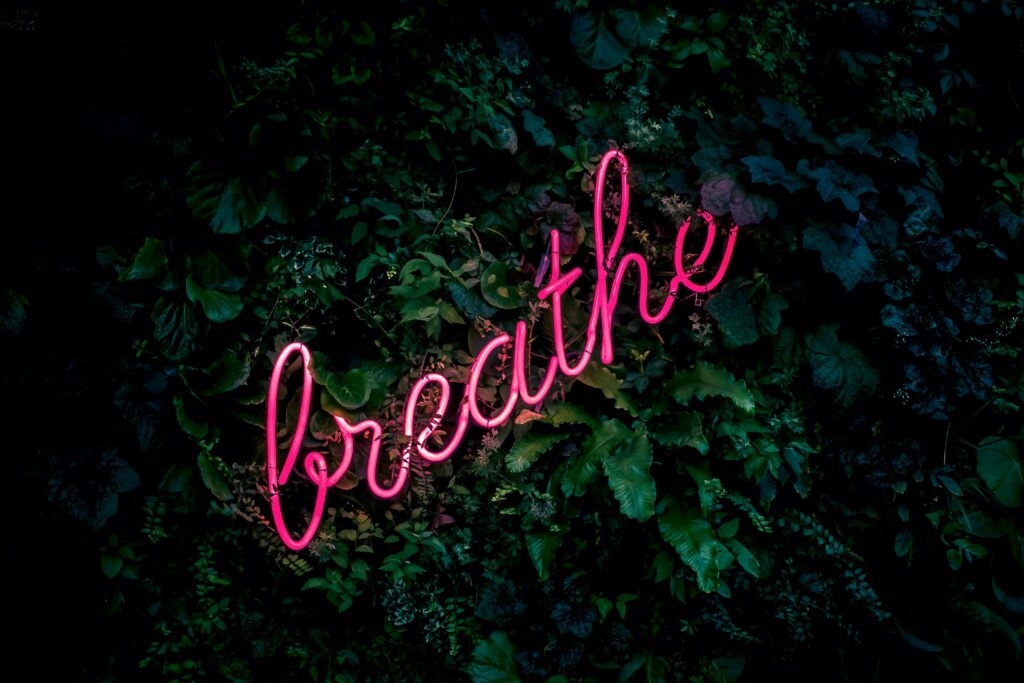
You’re already breathing. You’ve been doing it your whole life, about 20,000 times a day.
But there’s a strong chance you’ve been doing it in a way that keeps your nervous system stuck in low-level stress mode (shallow, rapid, chest-based breathing) without ever realizing it.
Diaphragmatic breathing (breathing that drops into your belly rather than lifting your chest), activates the parasympathetic nervous system, your body’s rest-and-digest state.
It slows the heart rate, lowers blood pressure, reduces cortisol, increases oxygen delivery to your cells, and directly stimulates the vagus nerve, which is the primary highway of your body’s relaxation response.
One study found that a structured breathwork practice significantly reduced cortisol levels and improved sustained attention in participants.
Three techniques worth trying — starting tonight:
Box breathing
Inhale for 4 counts, hold for 4, exhale for 4, hold for 4. Repeat 4-6 cycles.
This technique is used by Navy SEALs, surgeons, and emergency responders to regulate their nervous systems under pressure.
If it works in those situations, it will absolutely work for your Tuesday afternoon stress spiral.
4-7-8 breathing
Inhale for 4 counts, hold for 7, exhale slowly for 8.
The extended exhale is key — it activates the parasympathetic nervous system more powerfully than the inhale does.
This pattern is especially helpful as part of a bedtime wind-down.
Physiological sigh
A double inhale through the nose (one full breath, then a small sniff on top to fully inflate the lungs) followed by a long, slow exhale through the mouth.
This is the fastest known method for reducing acute stress, and your body already does it automatically when it’s overwhelmed — those involuntary deep sighs you catch yourself doing are your nervous system self-regulating in real time.
You can initiate it intentionally.
Start with 5 minutes a day. Pick one technique and stick with it for a week before experimenting with others.
The effects are cumulative — the more consistently you practice, the more readily your nervous system shifts into that calm, regulated state.
👉🏿 For more tips, read Breathwork for Beginners: A Simple Guide to Getting Started.
Mindfulness: Presence as a Daily Health Practice

Mindfulness has become a buzzword, and I completely understand why that’s a turnoff. The wellness industry has wrapped it in so much packaging — the apps, the cushions, the retreats — that it’s easy to forget what it actually is.
Strip all of that away and what you have is one of the most thoroughly researched practices for human health in existence.
Decades of peer-reviewed science shows measurable reductions in anxiety, depression, chronic pain, blood pressure, and inflammatory markers in the body.
Here is what mindfulness actually is: it is the practice of noticing what is happening right now, in your body and your environment, without immediately reacting to it or judging it.
That’s it.
And here is why it matters so much for this journey specifically: most of us spent years living entirely in our heads — obsessing over past choices, anxious about future ones, eating without tasting, moving without noticing, breathing without feeling.
Simple habits to reconnect with your body naturally through presence:
1. Try a body scan in the morning.
Before you pick up your phone, before you get out of bed, spend 2-3 minutes slowly moving your awareness through your body from your feet to the crown of your head.
Notice what’s there — tension, warmth, heaviness, ease — without trying to change anything. Just check in.
This single practice reestablishes your relationship with your physical self first thing in the morning, before the noise of the day takes over.
2. Eat one meal a day without screens.
No phone, no TV, no podcast, no reading. Just your food, your senses, and the experience of eating. Notice the flavors, the textures, the temperature. Chew slowly.
This practice, more than almost anything else, changed my relationship with food.
When you’re truly present while eating, you naturally tune in to satiety cues, enjoy food more deeply, and make more nourishing choices without any effort or rules.
3. Use transitions as mindfulness anchors.
The moment you sit down in your car, the moment you walk through your front door, the moment you press “start” on the coffee maker — use these natural pauses as a cue to take one conscious breath and arrive fully where you are.
You don’t need to carve out special time. Transitions happen all day long. Use them.
4. Journal for 5 minutes before bed.
No prompts, no structure required. Just write whatever is circulating in your head. Worries, gratitude, random thoughts, frustrations, small wins.
The act of externalizing your internal experience clears mental clutter, helps you process emotions before they get stored as physical tension, and creates a quiet bookend to your day.
5. Practice the one-minute reset.
At any point during the day — at your desk, in the grocery store, standing in line — close your eyes, take three slow breaths, and ask yourself: What am I feeling right now? What does my body need?
One minute. It sounds almost too small to matter. It isn’t.
Presence is a practice. Every moment is a new opportunity to return to it, and none of the previous moments of distraction count against you.
How These Habits Work Together

Here’s what I want you to really see: none of these habits exist in isolation.
They reinforce each other in a beautiful, compounding cascade — and once you start noticing that cascade, it becomes one of the most motivating things about this whole journey.
Better sleep improves your mood and stress resilience, which makes movement feel less like a chore and more like something you genuinely want. More movement deepens your sleep and supports lymphatic flow.
Time in nature lowers your cortisol baseline, which makes breathwork easier and more effective, and makes mindfulness feel less like a discipline and more like a relief.
Staying hydrated supports your cellular energy, which makes every other habit more accessible.
And all of it is amplified and supported by the nourishing, plant-rich food you’re already working on.
This is the whole picture. This is what thriving actually looks like. Not one magic pill, not one perfect morning routine, but a living web of small, sustainable, interconnected choices that build on each other day by day.
Pick one habit from this list, the one that feels most resonant or most needed right now. Anchor it into your life for two solid weeks. Let it become familiar. Then add another.
The pace doesn’t matter. The direction does.
FAQs About Daily Habits
Q: How long does it take to see results from natural daily habits?
Most people notice something within 1-2 weeks of consistent practice, especially with sleep, hydration, and breathwork.
Significant shifts in energy, mood, mental clarity, and overall wellbeing tend to become undeniable within 4-8 weeks.
Your body is incredibly responsive when you give it what it needs. It wants to return to balance — it just needs your consistent cooperation to get there.
Q: Do I need to do all of these habits to see benefits?
Not at all. Any one of these habits, practiced with genuine consistency, will produce real and measurable results. The science on each of them stands fully on its own.
Start where you are, with what resonates most. Let the momentum build naturally.
Adding one good habit tends to make the next one easier because your body starts feeling better and your relationship with self-care begins to shift.
Q: Is breathwork safe for everyone?
For most healthy adults, techniques like box breathing, 4-7-8 breathing, and the physiological sigh are very safe and can be practiced daily without supervision.
If you have a cardiovascular condition, a respiratory condition like asthma or COPD, or if you are pregnant, check with your healthcare provider before beginning any structured breathwork practice.
The techniques described in this article are gentle and generally well-tolerated, but your individual health context always matters.

In Essence: You Were Made for This
Here’s the truth that took me a long time to realize: thriving is your default state.
Not some distant mountaintop you have to earn. Your actual, biological baseline — when you give your body what it needs, consistently, with patience and compassion.
These daily habits aren’t radical. They’re the fundamentals your body has been quietly asking for all along. We just got so overstimulated, so sold-to, so exhausted, that we forgot to listen.
Start small. Stay consistent. Be genuinely patient with yourself on the hard days, because there will be hard days and they don’t undo anything.
Every single good choice you make is quietly compounding in your body, building toward the version of yourself that you already know is waiting.
We’re in this together.
⭐ Let’s chat: Which of these daily habits feels most out of reach for you right now — and what’s one small first step you could take this week to begin? Drop it in the comments. Your experience might be exactly what someone else needs to read today.